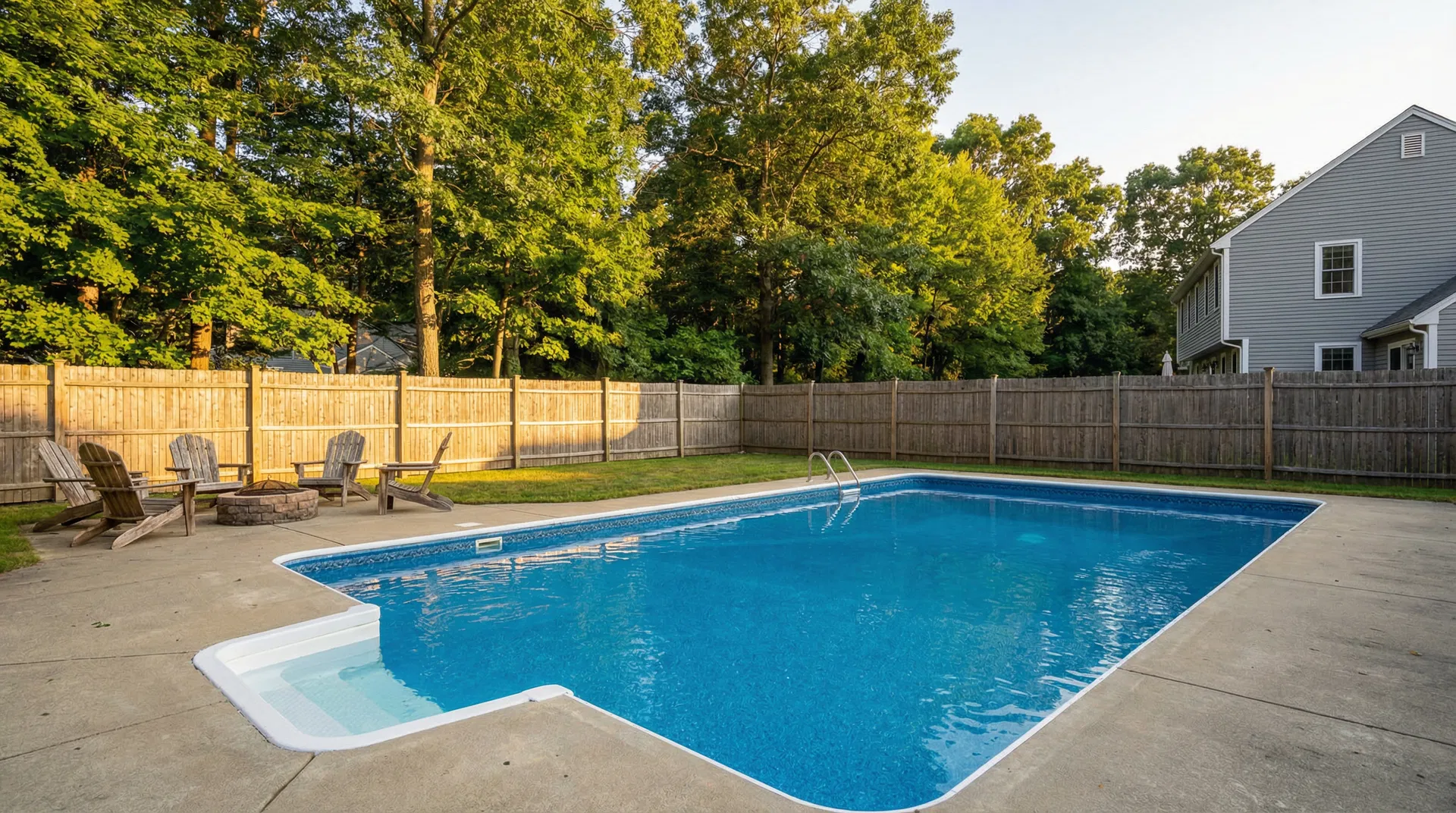
Planning Your Pool: A Realistic Timeline for New England
Building a pool in New England isn't like building one in Florida or Arizona. Our climate dictates a compressed building season, our soil conditions create unique challenges, and our permitting process requires advance planning. After 35+ years of building vinyl-lined inground pools across Central Massachusetts, we've developed a planning approach that accounts for all of these factors.


This guide walks you through the entire process — from your first conversation with us to the day you swim — with realistic timelines based on our actual experience in Brookfield, Charlton, Sturbridge, Spencer, and throughout our service area.
The New England Building Season
Massachusetts has a practical pool construction window of approximately April through November. The ground needs to be thawed for excavation, and temperatures need to be warm enough for liner installation (vinyl liners should be installed when temperatures are above 50°F for proper stretching and fitting).
| Month | Activity | Why This Timing Matters |
|---|---|---|
| January-February | Consultation, design, permits filed | Beat the spring rush; permits approved before ground thaws |
| March | Permit approval, materials ordered | Liner manufacturing takes 2-3 weeks; wall panels ordered |
| April-May | Excavation and construction begins | Ground thawed; optimal conditions for excavation |
| May-June | Construction, liner install, fill | Warm enough for liner; swimming by early summer |
| June-August | Peak construction season | Highest demand; longer wait times if not planned ahead |
| September-October | Late-season builds possible | Good conditions; may not swim until following spring |
| November | Final builds before freeze | Pool winterized immediately after completion |
"In our experience, homeowners who contact us in January or February and get permits filed early are swimming by Memorial Day or mid-June. Those who wait until spring to start the conversation are often looking at a July or August completion — if we have availability." — The Sapphire Pools Team
Site Assessment: What We Look For
Every pool project starts with a thorough site assessment. This isn't just measuring your yard — it's evaluating whether your property can support a pool and identifying potential challenges before they become expensive surprises.
Soil and Ground Conditions
Central Massachusetts has some of the most variable soil conditions in New England. Within our service area, we encounter:
- Ledge rock — Granite bedrock close to the surface is common in towns like Charlton, Sturbridge, and Monson. If we hit ledge during excavation, it needs to be removed (blasted or hammered), which adds cost and time.
- High water table — Properties in low-lying areas, near rivers (Quaboag River corridor), or adjacent to wetlands may have seasonal groundwater issues. We assess this during the site visit and plan drainage accordingly.
- Clay soil — Heavy clay doesn't drain well and can create hydrostatic pressure against the pool structure. Proper backfill and drainage systems are essential.
- Sandy/gravelly soil — Actually ideal for pool construction — drains well and is easy to excavate. Common in parts of Palmer and Warren.
"A project we completed in Brookfield required dewatering during excavation because we hit the water table at 4 feet. We anticipated this based on the property's proximity to a seasonal stream and had pumps ready. Without that preparation, the excavation would have been a muddy mess that delayed the project by days." — The Sapphire Pools Team
Access and Equipment Path
Excavation equipment needs to reach your backyard. We need a path at least 8-10 feet wide for our excavator. During the site assessment, we evaluate:
- Driveway width and any gates or narrow passages
- Overhead obstructions (power lines, tree branches)
- Underground utilities (gas, electric, water, sewer/septic)
- Existing landscaping that may need temporary removal
- Grade changes and slopes that affect equipment access
One advantage of vinyl liner pools over fiberglass: our equipment is standard-sized and can navigate tighter access paths than the flatbed trucks and cranes required for fiberglass shell delivery. See our vinyl vs. fiberglass comparison for more on access considerations.
Utilities and Infrastructure
Before we dig, we need to know what's underground. Massachusetts law requires a Dig Safe notification (811) before any excavation. We also check:
- Electrical service — Your panel needs capacity for the pool pump, heater, and lighting. Most pools require a dedicated 30-60 amp circuit. Older homes may need a panel upgrade.
- Water supply — Filling a pool takes 15,000-25,000+ gallons. We need to confirm your well can handle this (if on well water) or coordinate with the municipal water department.
- Septic system location — The pool must maintain required setbacks from the septic tank and leach field. We obtain the septic plan from your town's Board of Health.
Designing Your Pool
With a vinyl liner pool, you're not choosing from a catalog of pre-made shapes — you're designing a pool that fits your property, your family, and your vision. Here's what we discuss during the design phase:
| Design Decision | Options | Our Recommendation |
|---|---|---|
| Shape | Rectangle, L-shape, kidney, freeform, geometric | Match to yard shape and intended use (laps vs. recreation) |
| Size | 12×24 (small) to 20×40+ (large) | Consider setbacks, deck space, and future landscaping |
| Depth | 3 ft shallow to 8+ ft deep end | Consider who uses it — kids need shallow areas; diving needs 8 ft+ |
| Wall panels | Galvanized steel or polymer | Polymer for salt systems; steel for traditional chlorine |
| Liner pattern | Hundreds of patterns and colors | Darker patterns hide debris; tile borders add elegance |
| Features | Tanning ledge, bench seating, steps, spa | Plan features now — easier to build in than add later |
| Surround | Concrete, pavers, natural stone, composite deck | Budget for at least 4 ft of deck on all sides |
For homeowners interested in premium features, see our luxury vinyl liner pool page for inspiration on what's possible with custom design.
Common Planning Mistakes
After thousands of consultations, these are the mistakes we see most often:
- Not budgeting for the complete project. The pool itself is only part of the cost. You also need fencing, decking/patio, electrical work, landscaping restoration, and potentially a new equipment pad. Plan for the full picture from the start.
- Ignoring the deck/patio space. A pool without adequate surrounding space feels cramped. We recommend at least 4 feet of deck on all sides, with a larger area on one side for lounging and entertaining. See our deck and patio services.
- Waiting too long to start. If you want to swim by summer, start the conversation in January. By March, our schedule fills up for the peak season.
- Not checking property boundaries. "I think the property line is over there" isn't good enough. Get a survey or at least locate your property pins before committing to a pool location.
- Forgetting about winter. Your pool area needs to look good year-round. Consider how the pool, fence, and equipment will look during the 5 months you're not swimming. Safety covers, equipment enclosures, and thoughtful landscaping make a difference.
- Underestimating the electrical requirements. Pool pumps, heaters, and lighting require significant electrical capacity. If your home has an older 100-amp panel, you may need an upgrade. We identify this during the site assessment.
The Construction Process: What to Expect
Once permits are approved and materials are ordered, here's what happens on your property:
| Day | Activity | What You'll See |
|---|---|---|
| Day 1-2 | Excavation | Excavator digs the hole; soil is removed or graded on-site |
| Day 3-5 | Wall panel installation | Steel or polymer panels set on concrete footings; braced |
| Day 5-7 | Plumbing and floor | Pipes run for skimmers/returns; vermiculite or concrete floor poured |
| Day 7-8 | Liner installation | Custom liner hung, vacuum-fitted, and secured |
| Day 8-10 | Fill, equipment, electrical | Pool fills with water; pump, filter, heater connected |
| Day 10-14 | Backfill, deck, fence | Area around pool finished; fencing installed; inspections called |
Weather can affect this timeline — heavy rain delays excavation, and extremely hot days can make liner installation tricky (the vinyl becomes too pliable). We build weather contingency into every project schedule.
Financing Your Pool
Most homeowners finance their pool rather than paying cash. We partner with HFS Financial to offer pool loans up to $475,000 with competitive rates and flexible terms. Key points:
- Loans available for the complete project (pool + deck + fence + landscaping)
- No home equity required — unsecured personal loans available
- Pre-approval doesn't affect your credit score (soft pull)
- Funds disbursed directly to you for project management
Read our detailed pool financing guide for more information on options, qualification, and how to budget for monthly payments.
Your First Steps
Ready to start planning? Here's what we recommend:
- Schedule a consultation. Call or text us at (508) 692-6092 or fill out our contact form. We'll visit your property, discuss your vision, and assess site conditions — no charge, no pressure.
- Gather your property information. If you have a plot plan, survey, or septic plan, have them ready. If not, we can help you obtain what's needed.
- Think about how you'll use the pool. Family recreation? Lap swimming? Entertaining? This shapes the design. Browse our project gallery for inspiration.
- Consider your budget range. Be honest about what you can invest — we'll design a pool that maximizes value within your budget. Get pre-approved for financing to know your purchasing power.
- Start early. The earlier you begin, the more scheduling flexibility we have. January-February consultations lead to May-June swimming.
Frequently Asked Questions
How long does it take to build a vinyl liner pool in Massachusetts?
Construction typically takes 2-4 weeks once we break ground. The total timeline from first consultation to swimming is usually 8-16 weeks depending on permit complexity and scheduling. If Conservation Commission review is needed, add 4-8 weeks for that process. Starting in January-February gives you the best chance of swimming by early summer.
What's the best time of year to start a pool project in New England?
Start the planning and permitting process in January or February. This gives time for permits to be approved before the ground thaws in April, when construction can begin. Homeowners who start in spring are often looking at mid-to-late summer completion due to scheduling demand.
What if there's ledge rock on my property?
Ledge rock is common in Central Massachusetts, particularly in Charlton, Sturbridge, and Monson. If we encounter ledge during excavation, it needs to be removed using hydraulic hammers or, in some cases, controlled blasting. This adds cost and time to the project. During our site assessment, we look for indicators of shallow bedrock and discuss the possibility with you upfront so there are no surprises.
Do I need to be home during construction?
No, you don't need to be home for most of the construction process. We'll need access to your property and electrical panel, and we'll coordinate with you on key decisions (like final liner positioning). We keep you updated throughout the process and schedule a walkthrough before the final inspection.
What happens to my yard during construction?
Pool construction is disruptive — there's no way around it. Heavy equipment will cross your yard, excavated soil needs somewhere to go, and the area around the pool will be bare dirt until landscaping is complete. We minimize the impact by planning equipment paths carefully and grading the site after construction. Most homeowners complete their landscaping restoration within a few weeks of pool completion.
Can I build a pool on a sloped yard?
Yes, but slopes add complexity and cost. A sloped yard requires more excavation on the high side and potentially a retaining wall to manage the grade change. The upside is that sloped properties often create dramatic, multi-level pool areas with great views. We assess slope during the site visit and design solutions that work with your terrain rather than fighting it.
What size pool should I get?
Pool size depends on your lot dimensions (after setbacks), budget, and intended use. For family recreation, we typically recommend at least 14×28 feet. For lap swimming, a 12×40 or longer rectangle works well. For entertaining, wider pools (16×32+) with shallow tanning ledges are popular. We'll help you determine the optimal size during your consultation based on your specific property and goals.
Does a pool increase my property value?
In our market (Central Massachusetts), a well-maintained inground pool typically adds value to a home — though the exact amount varies by neighborhood, pool condition, and buyer preferences. More importantly, a pool adds significant lifestyle value for the years you live in your home. We recommend building a pool because you want to enjoy it, not purely as a financial investment.
What equipment do I need for my pool?
Every pool needs a pump, filter, and sanitization system at minimum. We recommend variable-speed pumps (required by law for new installations in many states) for energy efficiency. Optional equipment includes heaters (gas or heat pump), salt chlorine generators, automatic cleaners, LED lighting, and automation systems. We discuss equipment options and their long-term costs during the design phase. See our equipment upgrades page for details.
How do I get started?
Call or text us at (508) 692-6092 to schedule a free consultation. We'll visit your property, discuss your vision, assess site conditions, and provide a detailed proposal. You can also fill out our contact form online. There's no charge and no obligation — just an honest conversation about what's possible on your property.
Key Takeaways
- Start planning in January-February for a summer installation — permits and scheduling fill up fast.
- Site assessment is critical — soil conditions, access, utilities, and setbacks all affect your project.
- Vinyl liner pools offer unlimited design freedom — shape, size, depth, and features are all customizable.
- Budget for the complete project: pool + deck + fence + electrical + landscaping.
- Construction takes 2-4 weeks once permits are approved and materials arrive.
- Financing is available up to $475,000 through our lending partner.